It starts with a math question & Get it right to draw free
At Kirastack you do not buy a number or a bid first — you answer a fun math question. Tokens pay for that question; a correct answer gives you free selection qualification. Then join Number pool or Lowest unique price as labeled on the product. Rules are published up front and anyone can verify the result.
Shipping address must match the product country
Each product belongs to one country market. Physical prizes ship to the delivery address you choose, and that address must be in the same country as the product — for example, a Cambodia product needs a Cambodia address. Submitting a Thailand address for a Cambodia product cannot be fulfilled, and tokens are not refunded. You may save addresses in multiple countries on one account; that is allowed — just use the matching address for each product. Merchant vouchers redeem at partner stores in that country; office pickup is confirmed by support. Switch to the right country/market at the top before browsing.
Two settlement modes
Selection eligibility comes from answering; the mode decides how winners are chosen. Each product uses exactly one mode (fixed at creation). Number pool asks whose selection number matches the time remainder; Lowest unique price asks who bid the lowest price that as few others also bid. Full steps and examples follow.
Number pool
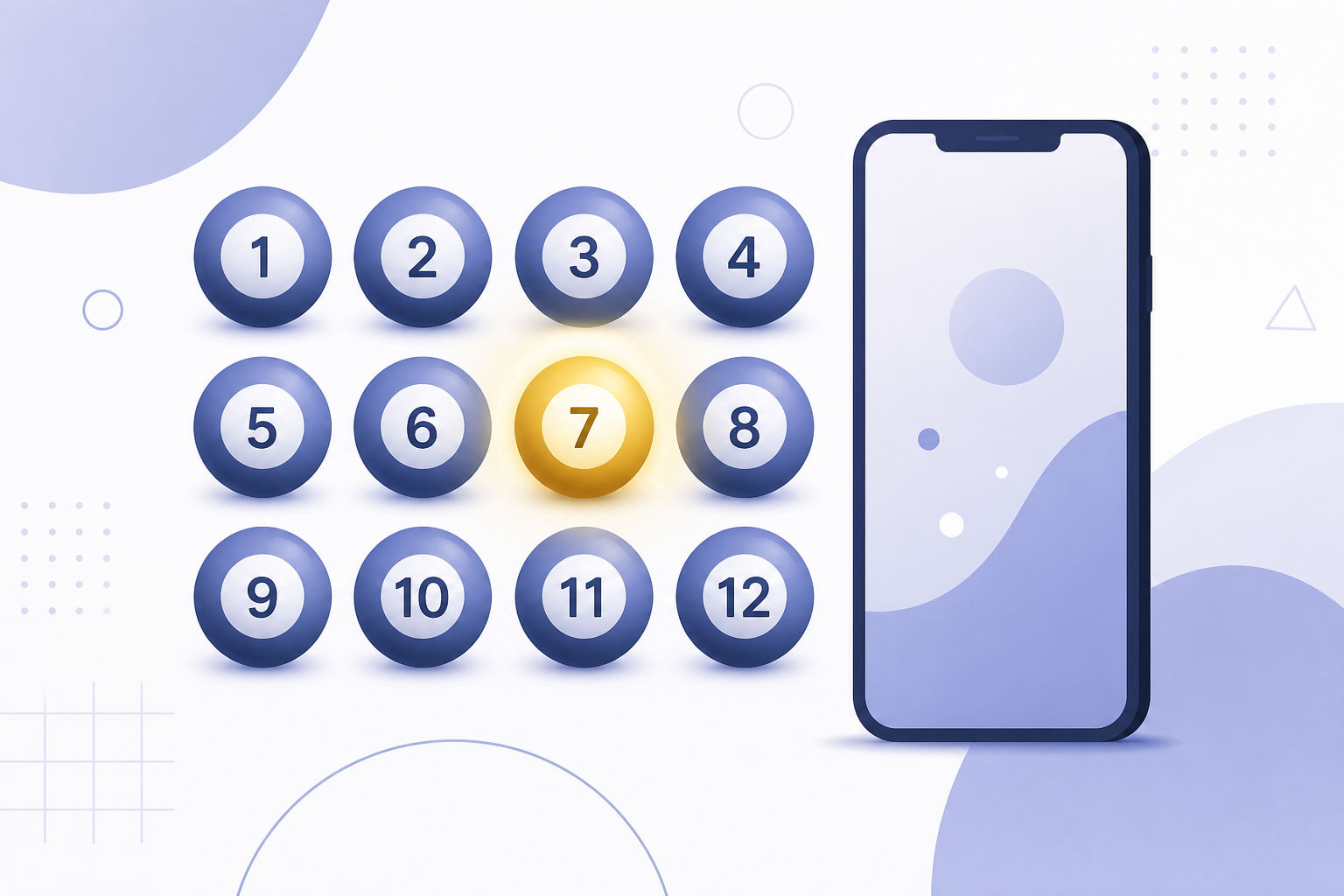
Each product has a fixed pool of selection numbers from 1 to N (N = total slots). You pick one or more free numbers; each number can be held by only one person. After the participation quota is full and the buffer checks pass, the winning number is decided by: sum of all order purchase times (ms) ÷ N → remainder. That remainder is the winner (remainder 0 means number N wins).
Lowest unique price
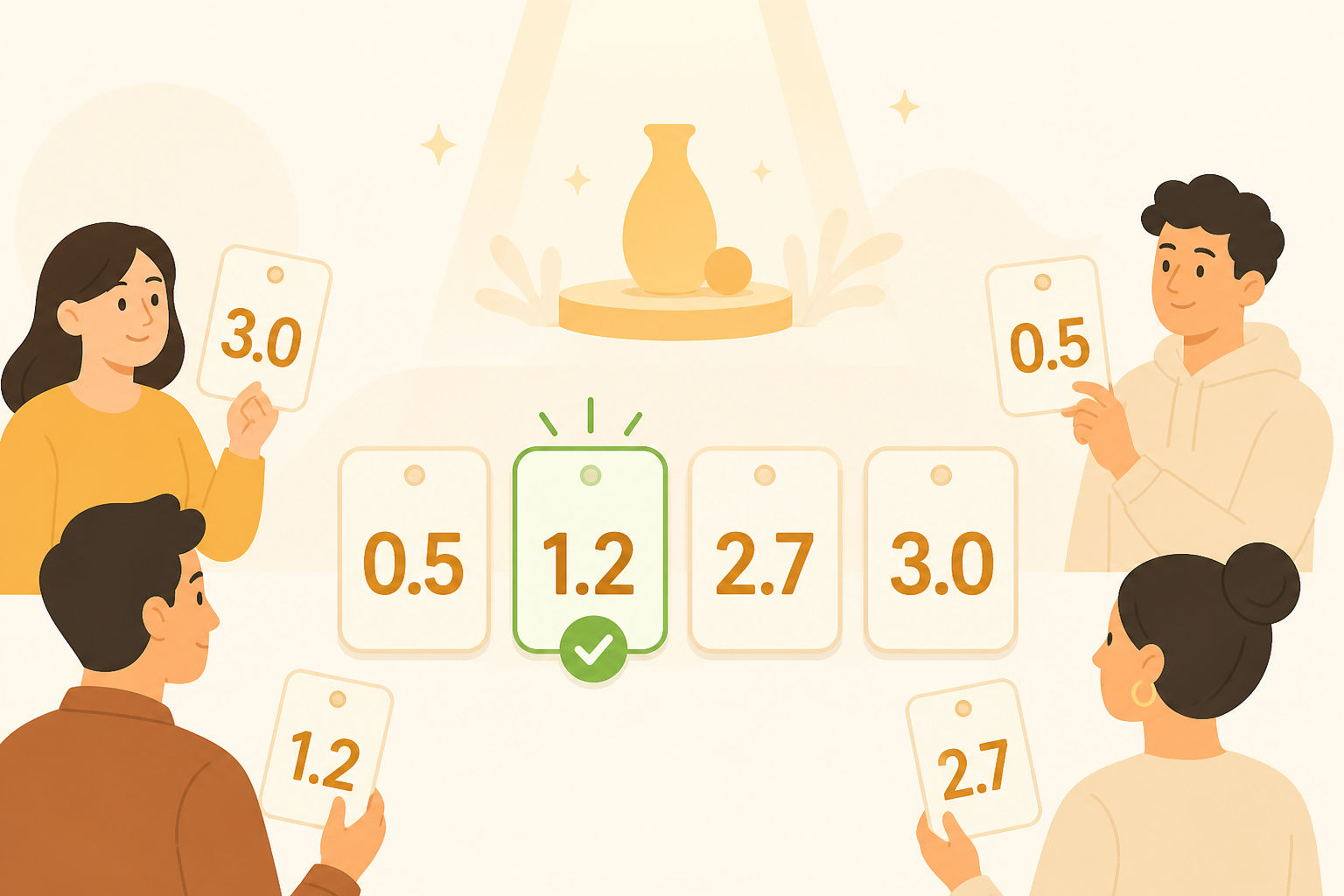
You do not pick a number. Instead you bid a price from 0 to 10 (up to 4 decimal places). The same price may be bid by many people. After the participation quota is full: first look for prices bid by exactly one person — the lowest of those unique prices wins. If every price was bid by at least two people, the overall lowest price wins, and the earliest order at that price wins ties.
Step-by-Step Guide

Top Up Tokens
Buy a token package. Tokens are shared across all markets — they are your ticket to the math question, not a price tag on numbers or bids. Answer correctly and selection eligibility opens for free.
Choose a product & mode
Confirm the correct country/market is selected at the top, then browse published products for that market on the homepage. Cards and detail pages show whether the mode is Number pool or Lowest unique price, plus total and remaining slots.
Answer correctly, unlock free selection qualification
When you confirm, solve one short math question first. Tokens cover that question; a correct answer unlocks free selection qualification and locks this entry. In Number pool you can pick several selection numbers (taken ones are blocked). In Lowest unique price you bid from 0–10 (up to four decimals; duplicates and multiple orders allowed).
Wait for Sell‑Out
Once all slots are filled, the product status changes to "Sold Out" and a roughly 15‑minute buffer begins. During this buffer, the system re‑checks every participant’s entry and runs the draw calculation three independent times; the result is confirmed only when all three runs match.
Result Settlement Runs Automatically
After the buffer and triple confirmation, the system publishes the result by that product’s fixed mode rule — no human picks the winner.
Winner Announced
The result page shows the winning number or winning bid, plus verification notes. Anyone can recompute from the published steps.
Number pool: how the winning number is chosen
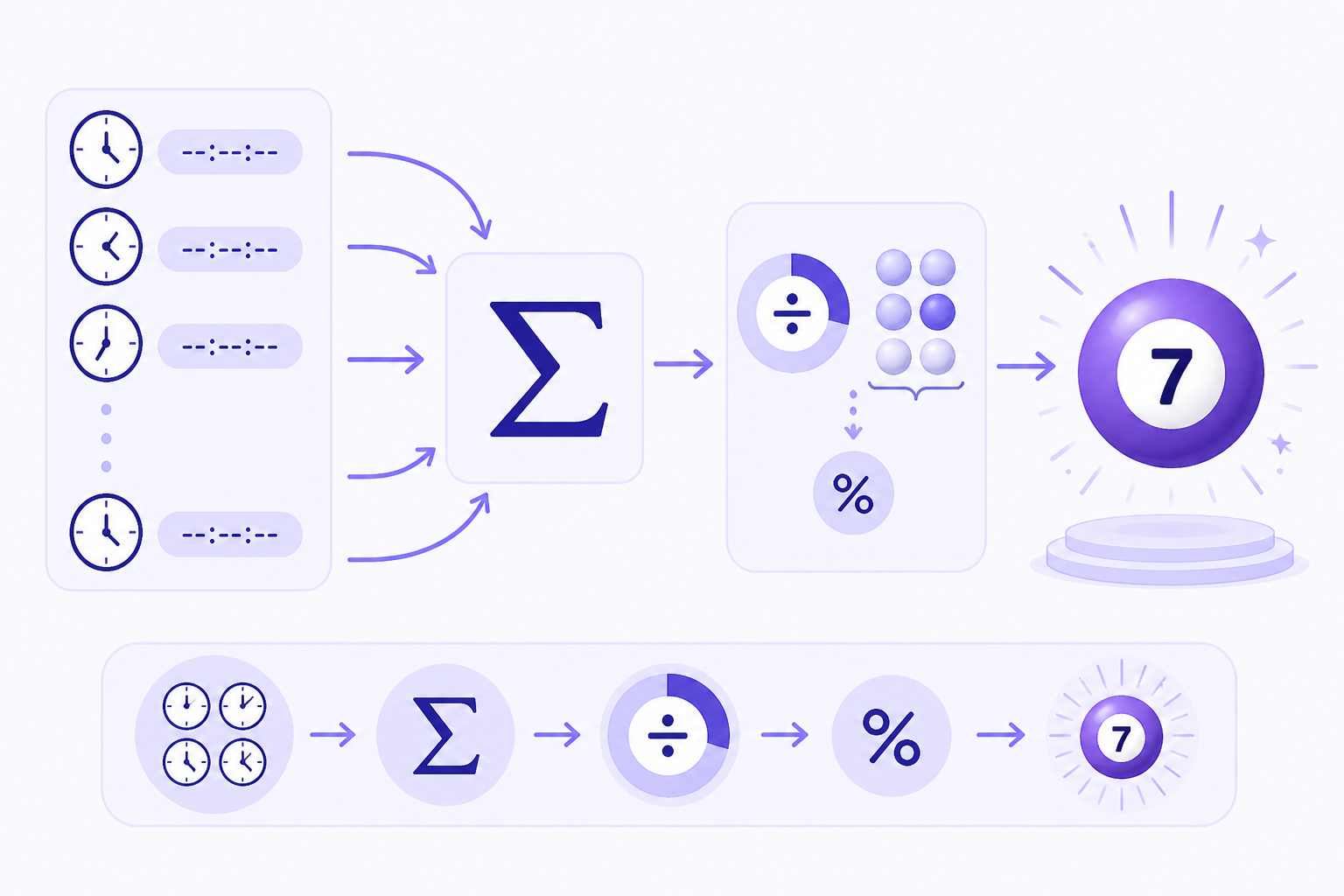
This mode is like a public calculator: every order’s exact purchase time is an input. Nobody can change past times after joining. After the participation quota is full and the ~15‑minute buffer (three matching recalculations), the system runs the same steps below.
- 1Add up the purchase time of every order on this product, precise to the millisecond. Example idea: 1710000000123 + 1710000000456 + … = one big total (call it S).
- 2Divide S by N (the total number of slots / selection numbers for this product). Keep only the remainder R. In math terms: R = S mod N.
- 3If R is 1, 2, …, N−1, that number wins. If R is 0 (S divides evenly by N), number N — the last number in the pool — wins. The person who holds that selection number is the winner.
Number pool — worked example
Suppose the product has only 5 selection numbers: 1, 2, 3, 4, 5. Five orders join (times simplified for teaching — real draws use full millisecond timestamps): • Order A time = 100 • Order B time = 120 • Order C time = 140 • Order D time = 160 • Order E time = 230 Step 1 — sum: S = 100 + 120 + 140 + 160 + 230 = 750 Step 2 — remainder: 750 ÷ 5 = 150 exactly, so R = 0 Step 3 — rule: R = 0 means the last number wins → winning number = 5 Whoever holds selection number 5 is the winner.
Another remainder case: if S were 752 instead, then 752 ÷ 5 = 150 remainder 2, so winning number = 2. Tip: you do not need to guess the times in advance — after result settlement, the result page lists the times used so anyone can add them up and check the remainder.
Lowest unique price: how the winning bid is chosen
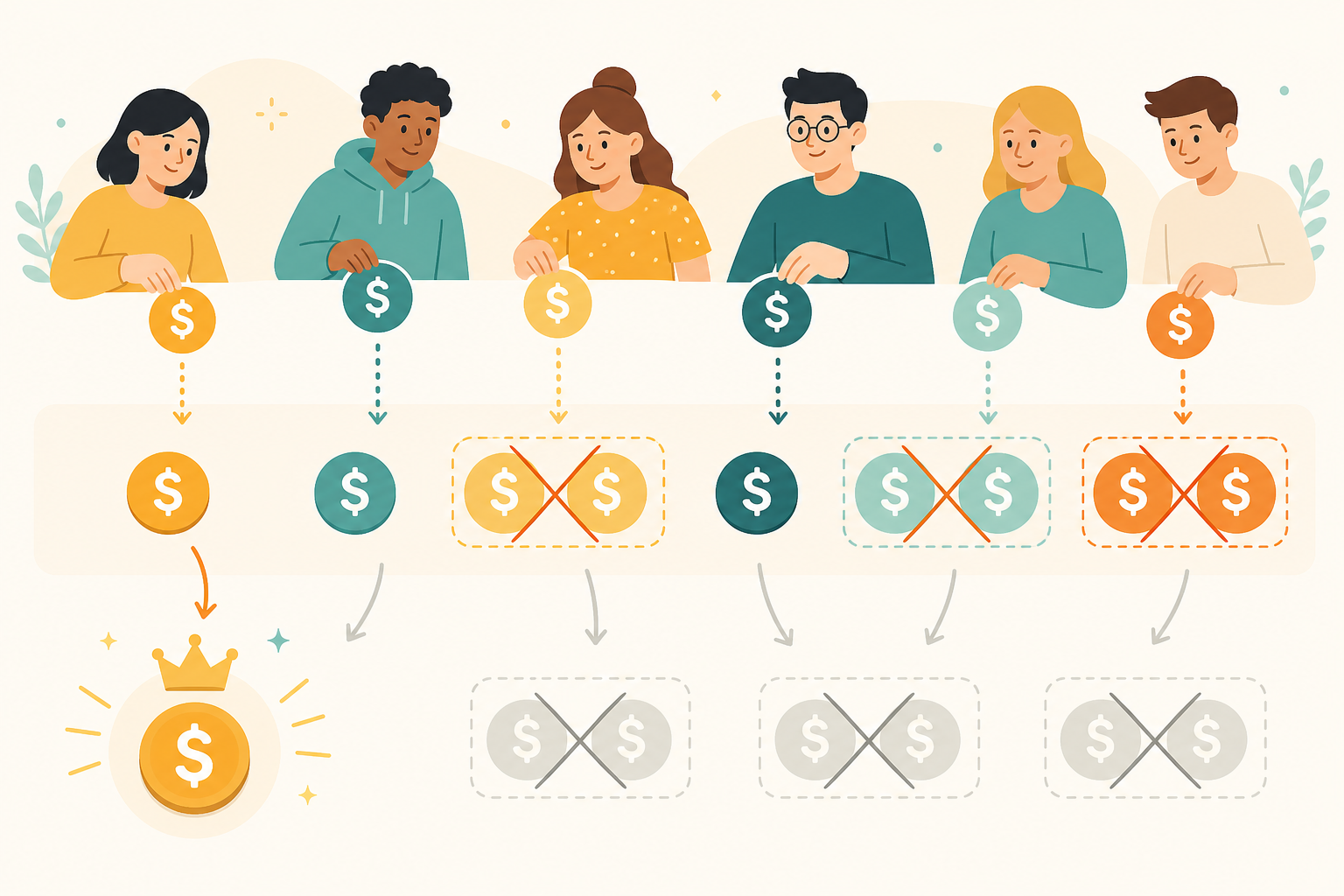
Here you compete on price, not on a number pool. The goal is to be the only person at a low price — “lowest unique”. Capacity still matters: the product still has a limited number of entries; when they sell out, the buffer and triple check run, then the rules below decide the winner.
- 1Collect every order’s bid (0–10, up to 4 decimals) and its purchase timestamp.
- 2Group orders by exact bid price and count how many orders share each price.
- 3Among prices that appear exactly once (unique bids), pick the lowest price. That single order wins.
- 4If no price is unique (every price appears 2+ times), fall back to the overall lowest price. If several orders share that lowest price, the earliest timestamp wins.
Lowest unique price — worked examples
Example A — a unique low price wins
Orders (bid → who): • 1.50 → Alice • 1.50 → Bob • 2.00 → Carol • 0.10 → Dave • 3.25 → Eve Count by price: • 1.50 appears twice (not unique) • 2.00 appears once (unique) • 0.10 appears once (unique) • 3.25 appears once (unique) Unique prices: 0.10, 2.00, 3.25. The lowest unique is 0.10 → Dave wins. Note: Alice and Bob both bid 1.50, so 1.50 is not unique and cannot win under the unique-price rule — even though 1.50 is higher than 0.10 anyway.
Example B — no unique price; earliest at the lowest price wins
Orders (bid → time): • 0.80 → 10:00:01 (Frank) • 0.80 → 10:00:05 (Grace) • 1.20 → 10:00:02 (Hank) • 1.20 → 10:00:08 (Ivy) Every price appears twice → there is no unique bid. Fallback: overall lowest price = 0.80. Frank and Grace both have 0.80; Frank’s time is earlier → Frank wins. Hank/Ivy at 1.20 lose because 1.20 is not the lowest.
Strategy intuition (not advice): bidding extremely low does not help if many people copy the same price — then that price is not unique. Being alone at a modestly low price often matters more than being one of many at the absolute floor. You may place multiple entries (each costs a math participation) with different bids, subject to remaining capacity.
Anyone can check
No Manipulation
Purchase times and bids are recorded when you join. Past orders cannot be changed later.
Rules fixed in advance
The result follows the published mode rules for that product — not a platform ad‑hoc lottery.
Anyone can check
After result settlement we publish the data and steps used. Anyone can recompute the same way.
FAQ
QCan the platform pick the winner?
No. The result is decided only by that product’s published mode rules and participation data.
QCan numbers or bids be duplicated?
Number pool: each number can be held only once. Lowest unique price: the same price may be bid by many people; result settlement prefers the lowest price bid by exactly one person.
QWhen is result settlement?
After the participation quota is full, a roughly 15‑minute buffer re-verifies entries and confirms the result with three matching calculations, then result settlement runs automatically.
QAre tokens refundable?
Token purchases are generally non-refundable because tokens are used to answer fun math questions. Selection eligibility after a correct answer is free. See the Disclaimer for details.
QHow do I receive a prize?
Winners are contacted by us. Physical prizes ship to a delivery address that matches the product’s country, or you may collect at a designated office (as confirmed by support); merchant coupons redeem at designated stores there. One account may store addresses in several countries, but each fulfillment must use an address that matches that product’s country. Photo ID is the account holder’s ID — bind it once; later wins reuse it.
QCan I join products from another country?
Yes. You can keep addresses for multiple countries on one account. What matters is that the delivery address used for fulfillment matches the product’s country — e.g. Cambodia products with a Cambodia address, Thailand products with a Thailand address. If they don’t match, we cannot ship, and tokens are not refunded.
Ready to play?
Pick a product, solve one math question for free selection qualification, then join Number pool or Lowest unique price.
View Products